
Quantum technologies: the next digital revolution
My article published in the FT and the Harwell Quantum Cluster launch

This article was published in PWM - Professional Wealth Management (a Financial Times affiliate publication) on November 14, 2025. The day after the Harwell Quantum Cluster (the home of UK NQCC - National Quantum Computing Centre) was launched in Oxfordshire.
At the opening, Quantum Exponential, a VC firm where I am a managing partner, signed a Memorandum of Understanding (MoU) to become a strategic partner of the cluster. Following the signing, we have launched fundraising for our new £100 million dedicated venture fund.
Please note that Oxford Quantum Circuits, Delta-G, Siloton and QLM Technology are our existing portfolio investments in Quantum Exponential’s Investment Vehicle I.
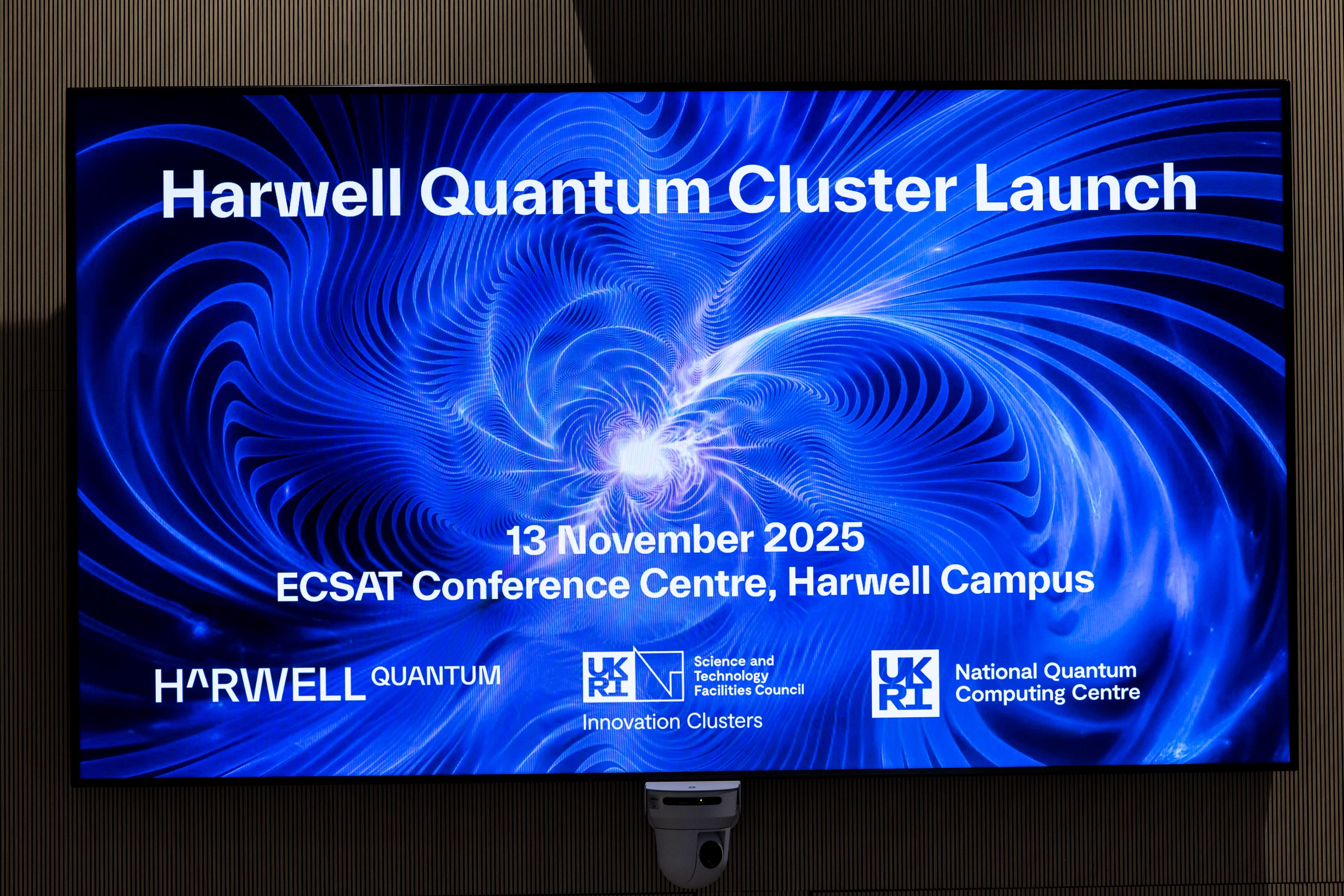
Julia Sutcliffe, the Department for Business and Trade’s Chief Scientific Advisor, delivered a keynote speech to mark the occasion [of the launch]:
“The launch of the Harwell Quantum Cluster marks a pivotal moment for the UK’s ambition to lead in quantum science and technology. By bringing together world-class research, industry expertise, and government support, we are building a collaborative ecosystem that will accelerate innovation, create high-value jobs, and deliver real-world impact across society.
It builds on this Government’s Industrial Strategy which allocated £670 million to support the UK quantum computing sector – with more to be announced to advance quantum technology across various industries including healthcare and sustainability. This cluster is not just an investment in technology, but in the future prosperity and resilience of the UK.”
The year 2025 marks a century since quantum mechanics reshaped modern science. And now it may be about to transform global finance. The United Nations has declared this the International Year of Quantum, and fittingly, the 2025 Nobel Prize in Physics went to pioneers of quantum computing. As if on cue, the sector’s investment activity has entered hyperdrive.
Publicly listed quantum companies have seen their share prices soar. In private markets, IonQ’s $1bn acquisition of Oxford Ionics caught headlines. Quantinuum, a joint venture between Honeywell and Cambridge Quantum, was valued at $10bn, making it the most valuable private quantum firm today.
Altogether, capital committed to quantum ventures has grown from roughly $1bn in the first quarter of 2025 to nearly $4bn by Q3.
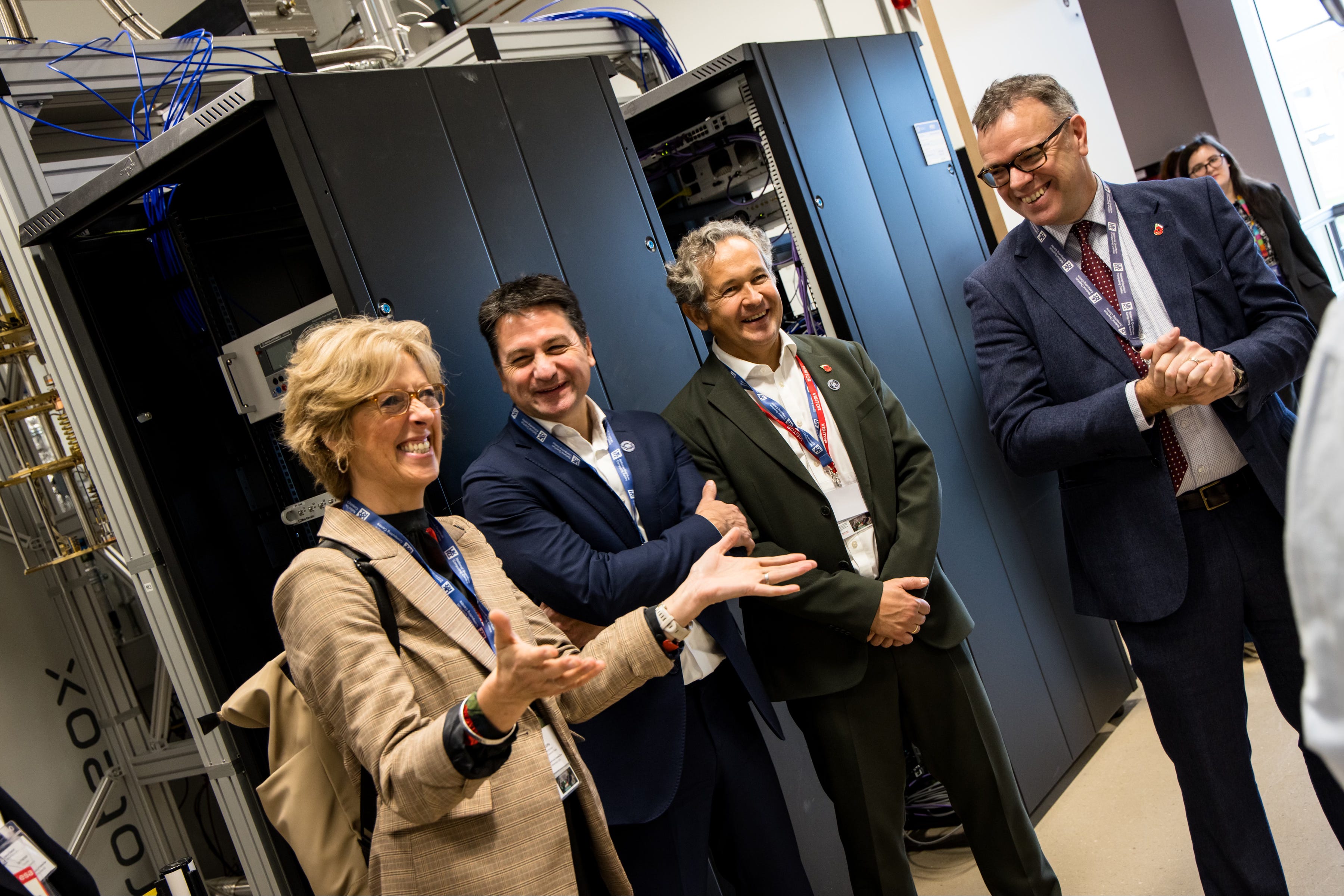
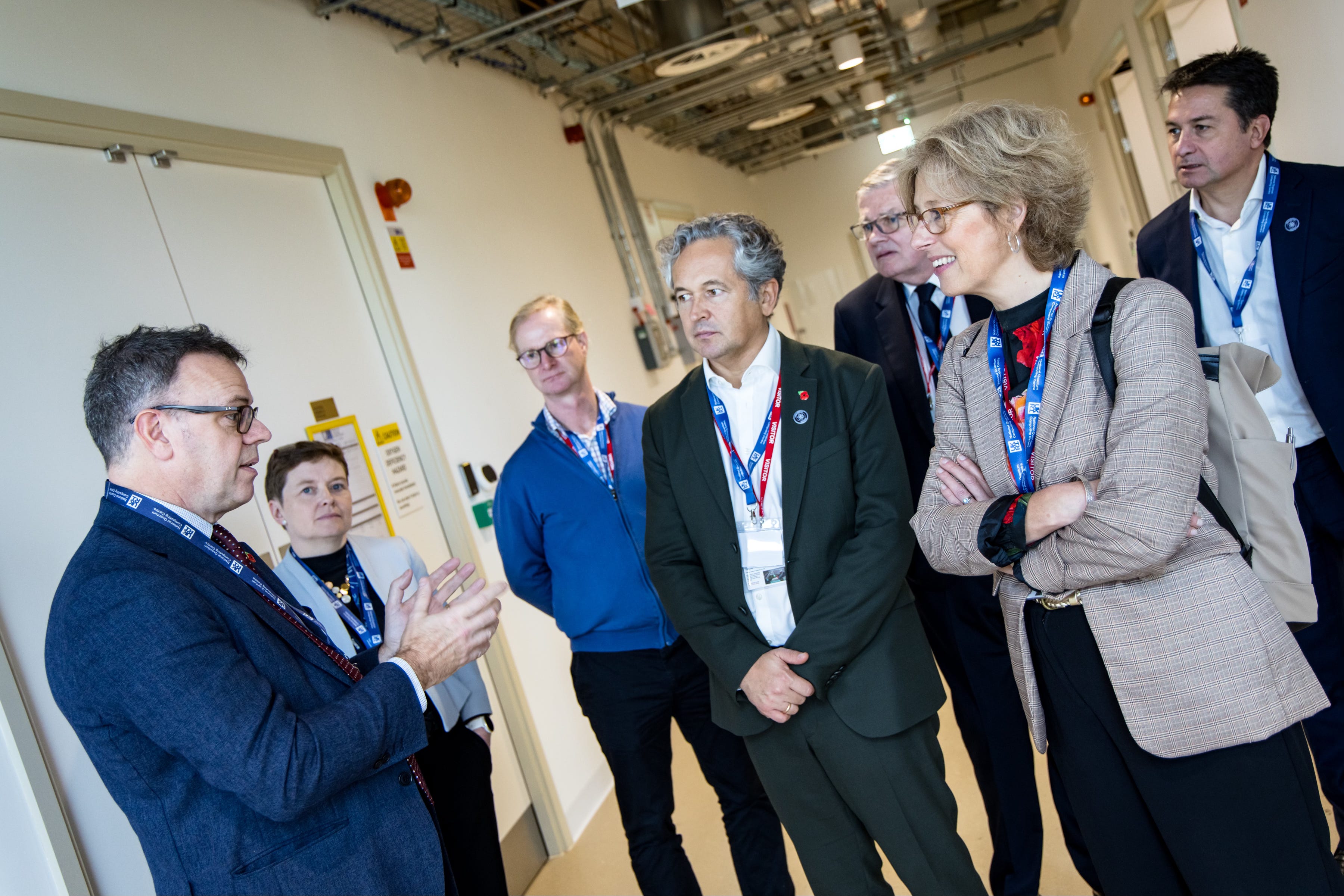
Photo (from left to right): Professor Julia Sutcliffe, Chief Scientific Adviser at the Department for Business and Trade; Steven Metcalfe, CEO of Quantum Exponential Group plc; Dr. Kirill Pyshkin, managing partner, Quantum Exponential; Dr. Michael Cuthbert, Director of the UK National Quantum Computing Centre (NQCC). November 13, 2025
While sceptics point to small revenues — even leading companies will struggle to earn $100m this year -— this misses the point.
Quantum computing is not another incremental upgrade in processing power. It represents a fundamental shift in how information is handled, exploiting the probabilistic behaviour of particles rather than the binary logic of classical bits. That leap could transform sectors from finance to energy, healthcare and cyber security.
Algo traders
Take financial services, the market likely to feel the earliest impact. In September, HSBC executed the world’s first algorithmic bond trade using an IBM quantum computer, achieving a 34 per cent improvement in predicting trade execution. That may sound academic, until one remembers that bond trading is a $145tn market.
At the same time, Oxford Quantum Circuits deployed its machine alongside Nvidia in New York’s first AI–Quantum data centre, aimed squarely at Wall Street. As Nvidia’s CEO Jensen Huang observed: “Quantum and AI are made for each other.” The two technologies are converging. Quantum computers can train AI models faster and more efficiently, while AI helps optimise quantum algorithms.

Quantum breakthroughs are not limited to computing. MRI scanners, now ubiquitous in hospitals, already rely on quantum effects to image tissue at microscopic resolution. The next wave of innovation is arriving in navigation, energy and medical diagnostics.
Delta-G’s ‘quantum compass’ is a navigation device that uses the Earth’s gravity instead of GPS, offering precise positioning even underground.
In environmental monitoring, QLM Technology’s photonic Lidar detects greenhouse gas leaks with remarkable precision; oilfield giant Schlumberger led its latest investment round.
And in healthcare, UK-based Siloton has developed a quantum sensor capable of spotting degenerative eye diseases such as glaucoma and macular degeneration at their earliest stages.
Each of these firms reflects a broader theme: quantum is shifting from lab experiments to commercial reality.
Speaking about the Harwell Quantum Cluster the Science and Technology Secretary Liz Kendall said:
“From helping doctors discover new medicines faster to batteries that last longer and charge quicker, quantum technology can keep us safer and healthier and change our everyday lives in really practical ways.
We have a once-in-a-generation chance to lead the world in quantum technology. This cluster at Harwell shows we’re serious about grabbing that opportunity and turning it into real prosperity – over 1,000 skilled jobs, £1 billion in private investment, and making sure the benefits are felt right across Britain.”
Economic opportunity
McKinsey estimates that quantum technologies could unlock as much as $2tn in economic value by 2035. The financial sector stands to gain most, but healthcare, materials and energy applications are not far behind.
National security agencies are also racing to secure early access. A sufficiently powerful quantum computer could, in theory, break today’s encryption standards. That makes quantum capability both a defensive necessity and a strategic asset. Unsurprisingly, government programmes are among the most active grant providers.
Valuations may appear lofty when measured against near-term revenues. Yet if quantum delivers even a fraction of its promise, these prices could still prove modest. The largest listed quantum computing company today is worth less half a per cent (0.5 per cent) of the biggest AI firm’s market value. Yet its potential addressable market is comparable.
For investors, the key is positioning early and selectively. Public markets offer limited choice, but the private sphere presents richer opportunities, especially among early-stage ventures developing critical components, software, or sensing technologies.
Many are finding the quantum subject itself is a barrier to investment entry. They are discouraged by the topic which is often seen as complex and filled with scientific jargon. As time moves on, breaking down these preconceived ideas by simplifying and using real-life investor case studies will open up the market and encourage investment. Of course this requires specialised due diligence, but the asymmetry of upside is substantial.
Quantum technology today sits roughly where AI was a decade ago: difficult to explain, expensive to develop, yet poised to redefine industries once the commercial tipping point arrives. Those who recognised AI’s potential early captured outsized gains. The same could soon be said for quantum.
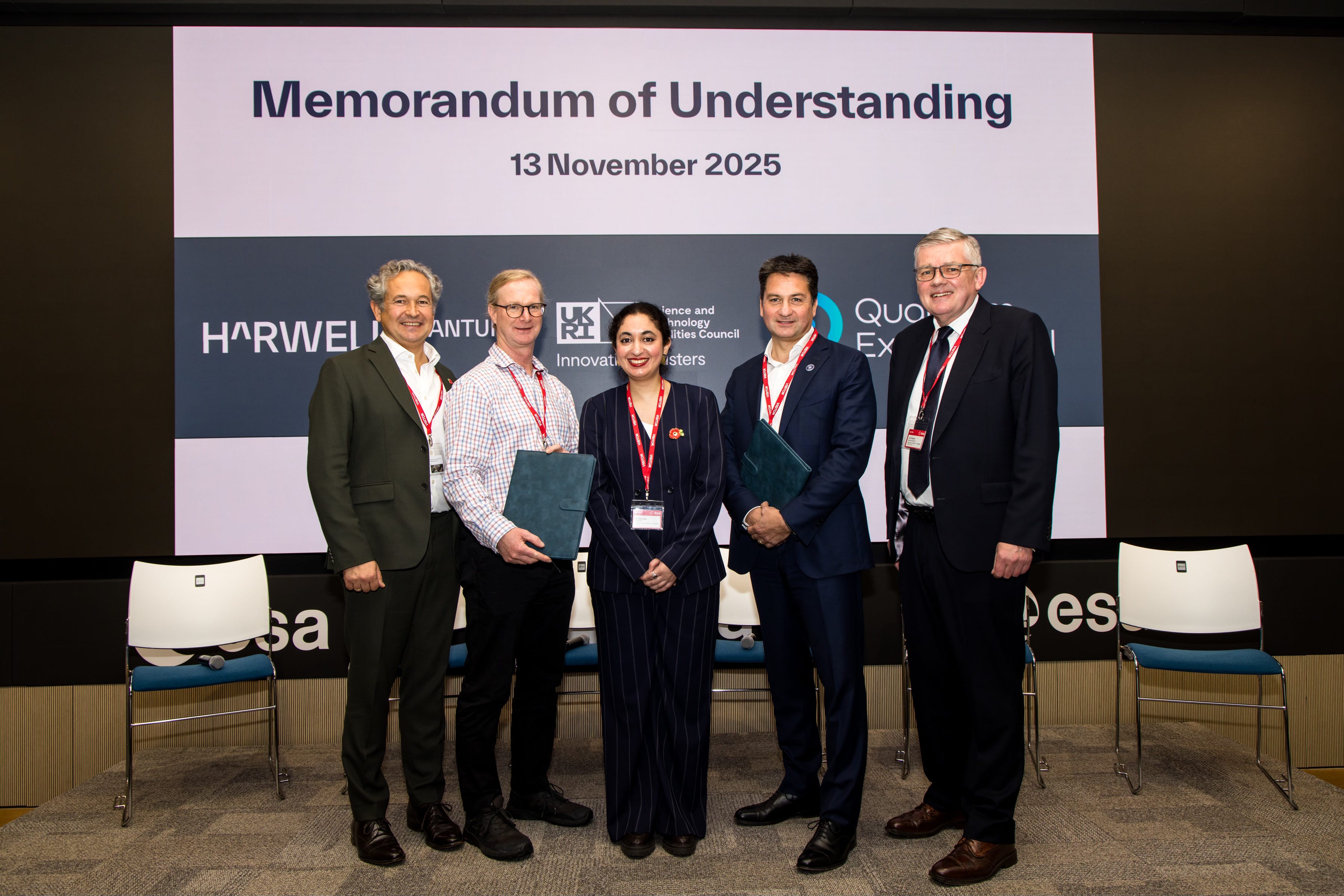
Photo of the signing of MoU between Harwell Quantum Cluster and Quantum Exponential. November 13, 2025. Please message me, if you’d like to know more or participate in the fund.
Disclosure
My articles represent my personal opinions and are provided for information purposes only. Their content is not intended to be an investment advice, or a personal recommendation to buy or sell any financial instrument or product, or to adopt any investment strategy as it is not provided based on an assessment of your investing knowledge and experience, your financial situation or your investment objectives. I use information sources which I believe to be reliable, but their accuracy cannot be guaranteed. The value of your investments, and the income derived from them, may go down as well as up. You may not get back all the money that you invest. The investments referred to in this article may not be suitable for all investors and, if in doubt, an investor should seek advice from a qualified investment advisor.
❤️🙏🏻